
Research
Anthropology, PhD Candidate | Nataliya Aluferova
(Dis)Trust and suspicion: perceptions of vaccinations among Russian-speaking people in Germany
The goal of the research is to analyse modes and degrees of trust and distrust in the German healthcare system among Russian-speaking people in Germany. Trust and distrust will be considered in the context of vaccinations (against not only the Covid-19 vaccines, but also regular vaccines such as chickenpox vaccine, etc.). March 2020 saw the first Covid-19 lockdown in Germany, with many subsequent waves of discussions about vaccinations and vaccines.
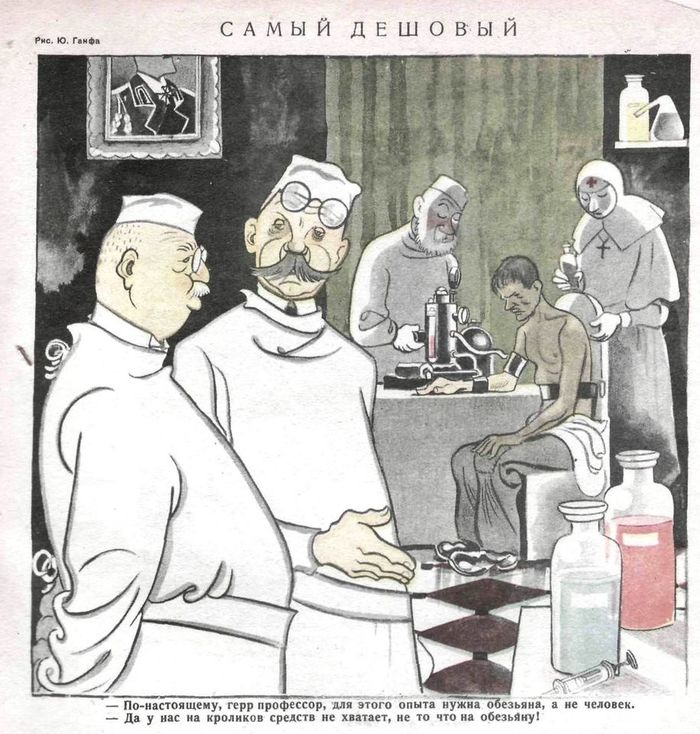
The phenomenon of lack of trust will be analysed in two contexts: (dis)trust at the social institutional level (vis-à-vis the German government and governmental healthcare); and mutual social (dis)trust at the interpersonal level. This entails an investigation of the functions of (dis)trust in creating alternative modes of quasi-governmental interaction in a situation whereby the measurements of established governmental structures are questioned or refused by the individuals. The focus will be on how feelings of (dis)trust affect people’s practices and define their perception of the German healthcare system.
Many researchers of trust emphasise the importance of trust: they strive to “solve” distrust as a phenomenon that may threaten the established social order. However, distrust itself may be a resource. The research assumption is that among Russian-speaking people who migrated from communist/post-communist settings to Germany, (dis)trust appears as a socially relevant category providing individuals and groups with a rationalised feeling of safety and control.
The project will contribute to growing research on distrust as a social-scientific concept and on the role of vaccinations in healthcare and social interactions.
See Nataliya Aluferova's research bio.
Contact Nataliya Aluferova directly via nataliya.aluferova"AT"uni-hamburg.de.
Supervisor: Prof. Dr. Otto Habeck
Cultural Studies, PhD Candidate | Dr. Carolin Albers
Stigma and the vaccine: unknowns around marginalisation and mental health in pandemic times
By exacerbating pre-existing health disparities and leading to tremendous social and financial straits, COVID-19 has impacted socially disadvantaged and marginalised groups to a special degree. While a growing body of research illustrates the adverse effects of discrimination distress on mental and physical health independent of COVID-19, the mutually reinforcing nature of marginalisation and mental health have become particularly salient in the context of the pandemic. Here, stigmatisation gains special significance as the highest incidences and lower vaccine uptake are reported in socially disadvantaged urban areas and, as a result, both become associated with social status and belongingness to certain social groups.

This social positionality is intricately entwined with ways of knowing health. While for a medical professional, decisions around health and vaccination are mainly based on a biomedical understanding of disease, the lived experience of those in socially disadvantaged positions may be primarily shaped by other criteria such as barriers to accessing health care and stigmatising experiences. However, the biomedical paradigm of health knowledge has priority in the clinical encounter and other forms of health knowledge are often not considered valid. While this epistemic inequality is not exclusive to the pandemic, the current and unprecedented circumstances accentuate the tension and render it more visible.
In her project, Carolin Albers aim to explore and analyse how knowledge is navigated in the clinical encounter between medical professionals and patients labelled as mentally ill and with (multiple) marginalisation experiences. Drawing on Miranda Fricker’s (2007) framework of epistemic justice, she strives to disentangle the role of marginalisation and prejudice in the production and communication of health knowledge in the extraordinary context of the COVID-19 pandemic and on the example of the corresponding vaccine.
See Carolin Alber's research bio.
Contact Carolin Albers directly via carolin.albers-1@uni-hamburg.de.(carolin.albers-1"AT"uni-hamburg.de)
Supervisor: Prof. Dr. Gertraud Koch
Cultural Studies, Post-Doctoral Researcher | Dr. Lesley Branagan
The Biopolitical Limits of Care: Vaccine-Related Illness, Biolegitimacy, and Moral Claims in the Covid-19 Pandemic
My research examines illness, care and contested forms of knowledge and authority through an interdisciplinary approach that brings medical anthropology into dialogue with political economy, science and technology studies, and theories of the state, care, gender, religion and kinship. My earlier work focused on India and includes ethnographic film.

Within the Knowing Vaccines project, my research explores the social dynamics and ethics of pandemic response and vaccination in Europe, particularly questions of biopolitics, moral claims and recognition. It focuses on people who report enduring Covid-19 vaccine-related illnesses and their struggles for healthcare and legitimacy within systems governed by uncertain biomedical and policy criteria, examining vaccine-related illness as an emerging biomedical category and biosocial identity within the broader context of vaccination programmes that saved millions of lives. My research also examines how experiences of vaccine-related illness become sites of contested voice, where people negotiate tensions between silencing, agency and the risks of speaking within the moral and political conditions of the pandemic.
See Lesley Branagan's research bio.
History, PhD Candidate | Peter Banks
Spatial Propaganda during the German Democratic Republic’s Poliomyelitis Vaccination Campaign
Considering vaccines are primarily concerned with public health and the wider wellbeing of the state, vaccines in their nature are characterised by a representative dimension which allows their semantics to go beyond just their medicinal purpose and become a means of propaganda. This is explicitly reflected in the GDR. In a similar manner to vaccines, socialism also correspondingly emphasises wider society. Likewise, acknowledging this shared characteristic between socialism and vaccines, from the 1950s onwards, the GDR adopted the slogan, ‘prophylaxis is the best form of socialism’, as a defining principle of the state’s medical ethics. This suggests there is a propagandistic relationship between vaccines and socialism.
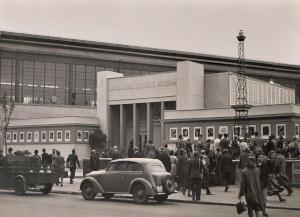
Moreover, to explore this relationship further, with the focus of poliomyelitis, this project will apply spatial theories to propaganda to facilitate an examination of vaccine related spaces that the state and its citizens engaged with. This analysis will explore how propaganda messages were spatially envisaged and presented at both a state and local level, examining different types of propaganda and assessing visual material such as images, posters, and architecture. Such an approach follows the demand from recent GDR historiography for research to maintain revisionism within the field by adopting interdisciplinary approaches. Thus, the project will further existing research concerning vaccination in the GDR whilst also contributing to the GDR’s wider historiography, providing a unique insight into the dynamics of interaction between the state and its citizens. In summary, this project will be a cultural history that applies spatial theory to propaganda to ultimately provide a broader understanding of the GDR and its poliomyelitis vaccination campaign.
See Peter Bank's research bio.
Supervisor: Prof. Dr. Ulf Schmidt
Media Studies, PhD Candidate | Tobias Becker
Visualities of vaccination under media transitions
Why are vaccines, despite being one of medicine’s most successful achievements, more contested than almost any other medical treatment? This research project argues that mediatization in general and visualisation in particular play a key role in understanding this controversial nature. Be it drawings, photographs, posters, film clips, memes and much more – a variety of visual representations are used to convince or, to the contrary, question the effectiveness of vaccination.
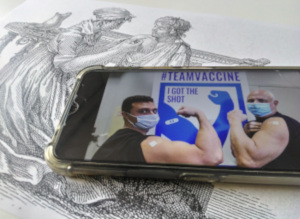
But what kind of images are brought forward by whom to articulate attitudes towards something as abstract and mostly invisible as vaccination? How did and do actors use public media of communication to influence discourses on vaccines? And in what ways have technological changes in modern audio-visual media been reflected in the imagery of vaccination?
Through the lens of media history, the project elaborates how the conditions of modern public media have influenced and shaped cultural knowledge about vaccination. The study pays particular attention to moments of media transition when new media of their time – such as photography, television or social media – impacted visual discourses on vaccination against smallpox, poliomyelitis and Covid-19 respectively.
In this sense, the research project examines how certain representations are used, appropriated and reinterpreted for particular communicative purposes under specific historical and cultural circumstances. Such a close look at iconographic schemes in times of media transition not only allows for a better understanding of the complexity and ambiguity of visualities of vaccination, but it also offers insights into both their transformations and traditions.
See Tobias Becker's research bio.
Contact Tobias Becker directly via tobias.becker"AT"uni-hamburg.de.
Supervisor: Prof. Dr. Kathrin Fahlenbrach